
Oct 16, 2026Materials & Surface Engineering
How to Choose the Right Material for a Motorcycle Rocker Arm
Learn how five material options compare for motorcycle rocker arms, and what to consider when balancing strength, wear resistance, weight, manufacturability and cost.
How to Choose the Right Material for a Motorcycle Rocker Arm
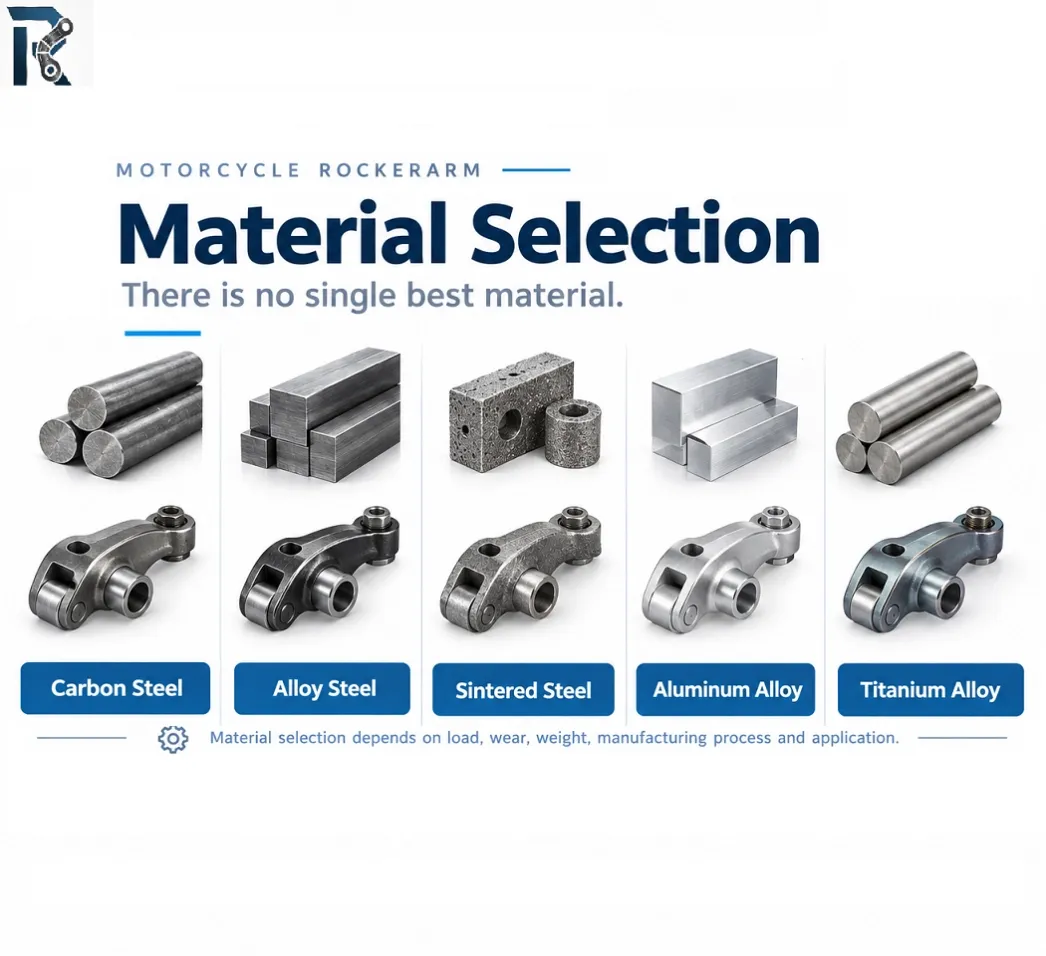
There is no single best material for every motorcycle rocker arm.
Material selection is not simply about choosing the strongest metal. It is about balancing strength, wear resistance, weight, fatigue performance, manufacturability and cost to meet the requirements of a specific application.
Carbon steel, alloy steel, sintered steel, aluminum alloy and titanium alloy each offer different advantages. Understanding these differences helps engineers make more informed decisions.
With more than 17 years of hands-on experience in motorcycle rocker arm production, I have learned that material selection should always be considered together with the component's design and manufacturing process.
What Factors Matter in Rocker Arm Material Selection?
Before comparing materials, it is important to understand the main requirements of a rocker arm.
Strength and fatigue performance: The component must withstand repeated loads during engine operation.
Wear resistance: Contact surfaces need to perform reliably under their specific loading and lubrication conditions.
Weight: Lower mass may be beneficial when reducing valvetrain inertia is a design priority.
Manufacturability: The material must be compatible with the required machining, forming and finishing processes.
Heat treatment: Where applicable, the material must achieve the required mechanical properties and surface hardness.
Cost: Material price, processing requirements and production volume all influence the overall manufacturing cost.
These factors are interconnected. Improving one property does not necessarily improve the performance of the complete component.
1. Carbon Steel: Balancing Performance and Cost
Carbon steel is a practical option for many mechanical components where strength, manufacturability and cost need to be balanced.
Depending on the design and required properties, grades such as 45 steel may be considered for certain rocker arm applications.
Potential advantages include material availability, machining practicality and cost-effective production. However, the suitability of carbon steel depends on the loading conditions, component geometry and required surface properties.
Heat treatment or other surface-processing operations may be necessary to meet specific requirements.
Carbon steel is not automatically suitable for every rocker arm. The grade and processing route must be selected according to the component's intended working conditions.
2. Alloy Steel: Strength and Heat-Treatment Flexibility
Alloy steel is often considered when strength, fatigue performance and heat-treatment capability are important.
Grades such as 40Cr, 4140 and 4340 may be used in different engineering applications, depending on the required properties and manufacturing route. These grades are not interchangeable, and their suitability must be evaluated individually.
Proper material selection and heat treatment can help achieve the required combination of strength, toughness and wear resistance.
However, alloy steel may involve additional material or processing costs. Heat treatment can also affect dimensional stability, making process control important for precision components.
From a manufacturing perspective, selecting an alloy steel is only the starting point. The heat-treatment specification, machining sequence and final surface condition must work together.
3. Sintered Steel: Advantages in Powder Metallurgy
Sintered steel is produced using powder metallurgy, in which metal powder is compacted and processed into a solid component.
For suitable designs and production volumes, this approach can offer near-net-shape manufacturing, efficient material utilization and good production repeatability.
These advantages depend on the component geometry, material formulation, density and manufacturing process.
Sintered materials also have limitations. Porosity, strength, fatigue performance and wear resistance must be evaluated for the intended application.
Not every sintered steel offers the same properties as conventional wrought steel.
The important question is whether powder metallurgy can meet the functional and quality requirements of the specific rocker arm at an acceptable production cost.
4. Aluminum Alloy: Reducing Moving Mass
Aluminum alloy is attractive when reducing component weight is a priority.
Because aluminum alloys have a much lower density than steel, they can help reduce valvetrain mass. In suitable designs, lower moving mass may improve dynamic response and reduce inertia-related demands on the system.
However, low density alone does not make aluminum alloy the best choice.
Strength, stiffness, fatigue performance, temperature conditions and contact-wear resistance all need to be considered. Depending on the design, additional surface treatment or separate wear-resistant contact components may be necessary.
The final decision should consider the complete rocker arm design, rather than comparing material density alone.
5. Titanium Alloy: Lightweight Performance at a Higher Cost
Titanium alloys may be considered when weight reduction and high specific strength are especially important.
For example, Ti-6Al-4V is used in demanding engineering applications. Its density is approximately 60% of that of typical steel, although the exact ratio depends on the materials being compared.
Titanium alloys can offer attractive strength-to-weight characteristics, but material cost and processing requirements are generally higher than for conventional steels.
Machining, contact behavior and the intended operating conditions also require careful consideration.
For these reasons, titanium is not automatically the best choice for a motorcycle rocker arm. Its benefits must justify the additional material and manufacturing costs for the specific application.
Why Material and Manufacturing Must Be Considered Together
One lesson from practical rocker arm production is that a material specification alone does not guarantee the performance of the finished component.
Heat treatment, surface condition, contact geometry, wall thickness, pivot design and machining accuracy can all influence the final result.
For example, a material may have adequate strength, but unsuitable contact geometry or poorly controlled surface finish can still contribute to friction and wear.
Similarly, heat treatment must be matched to the material and component design. The required hardness, toughness and dimensional stability need to be considered together.
In our manufacturing work, we pay attention not only to the material itself, but also to how the material behaves throughout production and how the finished functional surfaces relate to one another.
This is why material selection should begin with the component's actual requirements, rather than with a material name alone.
How Should Engineers Choose the Right Material?
A practical selection process starts with several questions:
- What loads and operating conditions will the rocker arm experience?
- Which contact areas are most critical for wear and durability?
- Is reducing moving mass a major design objective?
- What strength, fatigue and hardness requirements must be met?
- Which manufacturing and heat-treatment processes are available?
- Can the material meet the requirements consistently at an acceptable cost?
The answers help narrow down the options before testing and validation.
Where possible, material selection should be supported by the component drawing, technical specifications, operating requirements and appropriate verification.
The goal is not to maximize one material property. It is to achieve the required performance consistently throughout the intended service life.
Conclusion
Carbon steel, alloy steel, sintered steel, aluminum alloy and titanium alloy each offer potential advantages, but they are not interchangeable solutions for every motorcycle rocker arm.
The right choice depends on the balance between strength, wear resistance, weight, fatigue performance, manufacturability and cost.
After more than 17 years of working with motorcycle rocker arm production, my view is simple: the best material is not necessarily the strongest or most expensive one. It is the material that meets the specific requirements of the application and can be processed consistently into a reliable component.
In the next article, we will explore another important aspect of rocker arm manufacturing: why surface roughness matters and how it relates to friction, wear and durability.