
Oct 4, 2026Rocker Arm Basics
What Is a Motorcycle Rocker Arm? Understanding Its Function and Role in the Valve Train
Learn what a motorcycle rocker arm does, how it works in the valve train, and why its geometry, contact surfaces, and manufacturing accuracy matter.
What Is a Motorcycle Rocker Arm? Understanding Its Function and Role in the Valve Train
A motorcycle rocker arm may look like a simple mechanical component, but it plays an important role in the engine's valve train.
Its basic job is to transfer movement and force between the camshaft or pushrod and the valve. Depending on the engine design, the rocker arm can also change the amount of valve movement through its rocker ratio.
After more than 17 years working with motorcycle rocker arm production, we have learned that a rocker arm is much more than just a shaped piece of metal. Small differences in geometry, surface condition, or dimensional accuracy can affect how the part performs in the engine.
So, what exactly does a motorcycle rocker arm do?
What Is a Motorcycle Rocker Arm?
A motorcycle rocker arm is a pivoting lever used in the valve train of an internal combustion engine.
As the camshaft rotates, its cam profile creates movement that is transferred through the valve train to the rocker arm. The rocker arm then pivots around its shaft or pivot point and transfers this movement to the valve.
In simple terms:
Camshaft → Valve Train → Rocker Arm → Valve
Different motorcycle engines use different rocker arm designs. The shape, dimensions, pivot arrangement, and contact surfaces can vary depending on the engine architecture, displacement, performance requirements, and valve train layout.
Although the designs may look different, the basic principle remains the same: the rocker arm helps convert and transmit motion within the valve train.
How Does a Motorcycle Rocker Arm Work?
The rocker arm works as a mechanical lever around its pivot point.
When the camshaft rotates, the cam lobe generates movement at the input side of the valve train. This movement causes the rocker arm to rotate around its pivot.
The opposite side of the rocker arm then moves against the valve, opening it.
When the cam lobe moves away from its peak, the valve spring helps return the valve and rocker arm toward their original positions.
The basic sequence is:
Cam rotation → Rocker arm movement → Valve opening → Valve spring return
The actual movement depends on several factors, including the cam profile, rocker arm geometry, rocker ratio, valve clearance, and valve spring characteristics.
This is why a rocker arm should always be considered as part of the complete valve train rather than as an isolated component.
The Rocker Arm as a Mechanical Lever
One important characteristic of a rocker arm is its ability to work as a lever.
The relationship between the pivot point and the two contact points affects the rocker ratio. In a simplified form:
Rocker Ratio ≈ Input Arm Length / Valve-side Arm Length
The actual geometry is more complicated, but the basic principle is useful for understanding how rocker arm dimensions can influence valve movement.
This is also why changing the geometry of a rocker arm—even slightly—can change its mechanical behavior.
For engineers, the rocker arm therefore needs to be considered together with the cam profile and the rest of the valve train.
What Forces Act on a Motorcycle Rocker Arm?
During operation, a rocker arm is subjected to repeated loads and contact forces.
Three main force paths are worth considering:
1. Cam or Pushrod Force
Depending on the engine design, the rocker arm receives force directly from the camshaft or through another valve train component such as a pushrod.
This force is transferred through the rocker arm toward the valve.
2. Valve Spring Reaction
When the rocker arm opens the valve, the valve spring is compressed.
The spring then generates a reaction force that acts back through the valve and rocker arm.
This means the rocker arm is exposed to repeated loading throughout engine operation.
3. Pivot or Shaft Support
The rocker arm rotates around its pivot or shaft.
The pivot area therefore has to support the reaction forces while allowing the rocker arm to move smoothly and repeatedly.
These forces are closely related to the rocker arm's geometry and contact conditions.
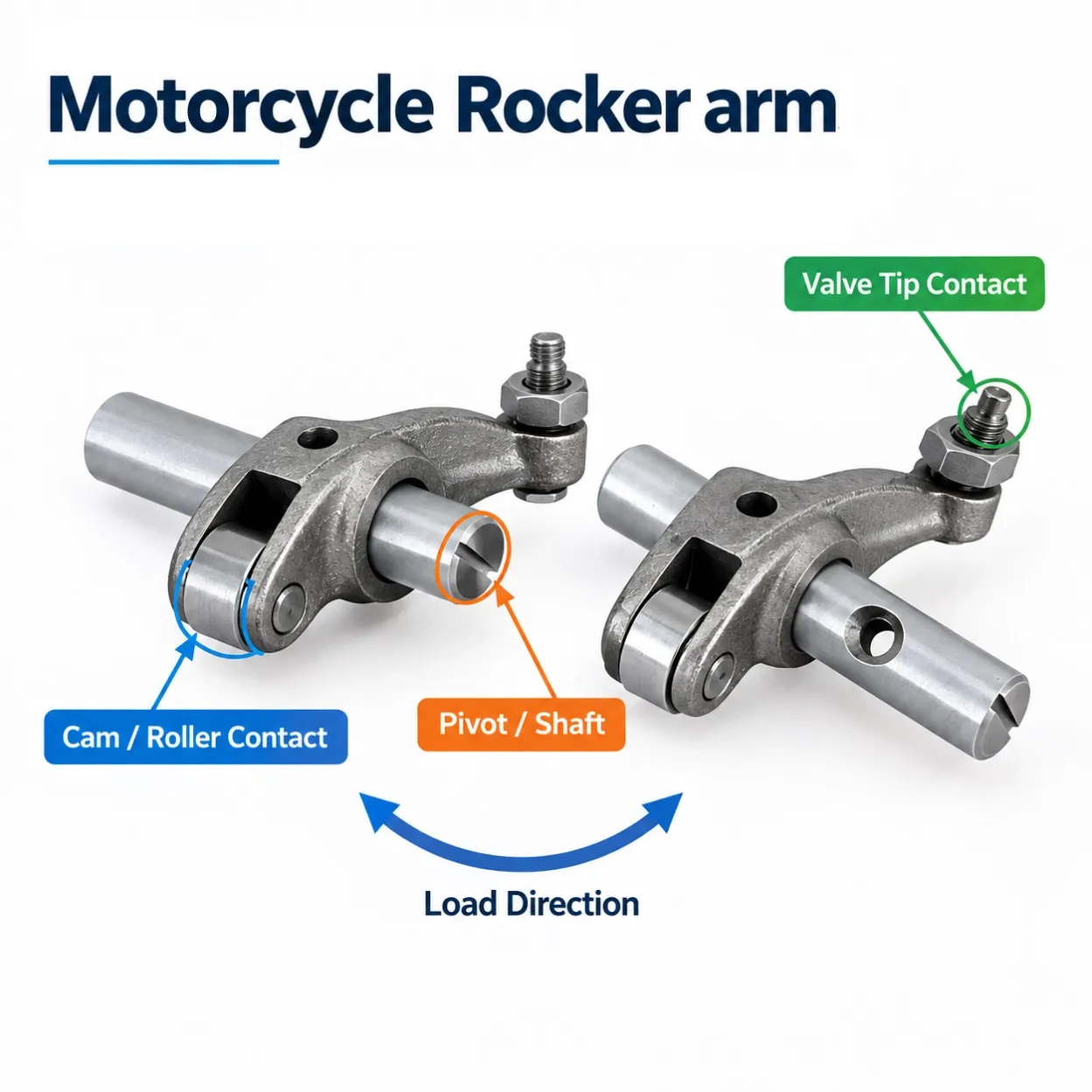
Three Important Areas of a Rocker Arm
When examining a motorcycle rocker arm, three areas deserve particular attention.
Cam-side or Input Contact
This is where the rocker arm receives movement and force from the cam-related part of the valve train.
The exact design depends on the engine, but the contact surface experiences repeated movement and loading.
Surface finish and contact geometry are therefore important for controlling friction and wear.
Pivot / Shaft Area
The pivot area allows the rocker arm to rotate.
The accuracy of the pivot hole, its surface condition, and its relationship with the other functional surfaces can all affect how the rocker arm operates.
In actual production, the pivot hole is one of the areas we pay close attention to. It is not enough for the hole to simply be within a dimensional tolerance. Its relationship with the rocker arm's other functional surfaces also matters.
Poor control of this area can contribute to excessive clearance, abnormal wear, or unwanted movement.
Valve-side Contact
The valve-side contact point transfers movement from the rocker arm to the valve.
Because this surface experiences repeated contact and loading, its geometry and surface condition are important.
Its position relative to the pivot also affects the effective rocker ratio and valve movement.
Why Does Manufacturing Accuracy Matter?
A rocker arm may be a relatively small component, but several manufacturing characteristics can influence its performance:
- Dimensional accuracy
- Pivot-hole accuracy
- Contact surface geometry
- Surface roughness
- Material properties
- Surface hardness
- Alignment between functional surfaces
- Production consistency
From a manufacturing perspective, these characteristics are connected.
For example, a correctly sized pivot hole does not automatically mean the rocker arm will perform correctly. The position of the hole, its relationship with the contact surfaces, and the overall geometry must also be controlled.
We have found through production experience that many rocker arm problems are not caused by one obviously bad dimension. They can come from the relationship between several small dimensional or surface differences.
That is why controlling the manufacturing process is important, especially for functional surfaces and critical dimensions.
Rocker Arm Performance Depends on the Whole Valve Train
It is also important not to evaluate a rocker arm completely on its own.
The cam profile, valve spring, valve clearance, rocker ratio, lubrication, pivot arrangement, and contact conditions all influence the working environment of the rocker arm.
For example, when investigating abnormal wear or noise, looking only at the rocker arm may not reveal the complete cause.
The interaction between components often tells us more than one component viewed by itself.
What Should Engineers Look at When Evaluating a Rocker Arm?
When evaluating a motorcycle rocker arm, some practical questions include:
- Is the rocker arm geometry suitable for the intended valve train?
- Is the pivot hole accurately controlled?
- Are the contact surfaces properly finished?
- Is the material appropriate for the application?
- Is the surface hardness suitable?
- Are the functional surfaces correctly aligned?
- How does the rocker arm interact with the cam, valve, and spring?
- Are wear patterns consistent between production batches?
These questions help move the discussion beyond simply looking at the shape of a rocker arm and toward understanding its actual working conditions.
Conclusion
The motorcycle rocker arm is a relatively small component, but it plays an important role in controlling valve movement.
Its job is not simply to transfer movement. Its geometry, pivot accuracy, contact surfaces, material, hardness, and surface condition all influence how it works within the valve train.
After more than 17 years of motorcycle rocker arm production, one thing we have learned is that small manufacturing details can have a significant effect on the final working performance of the part.
Understanding these fundamentals provides a good starting point for deeper discussions about rocker arm materials, surface roughness, hardness, machining accuracy, wear, and manufacturing processes.
In the next articles, we will explore these topics from a practical manufacturing perspective.