
Oct 18, 2026Materials & Surface Engineering
Why Does Surface Roughness Matter in Motorcycle Rocker Arm Manufacturing?
Discover how surface roughness, contact geometry and finishing processes affect friction, wear and contact performance in motorcycle rocker arms.
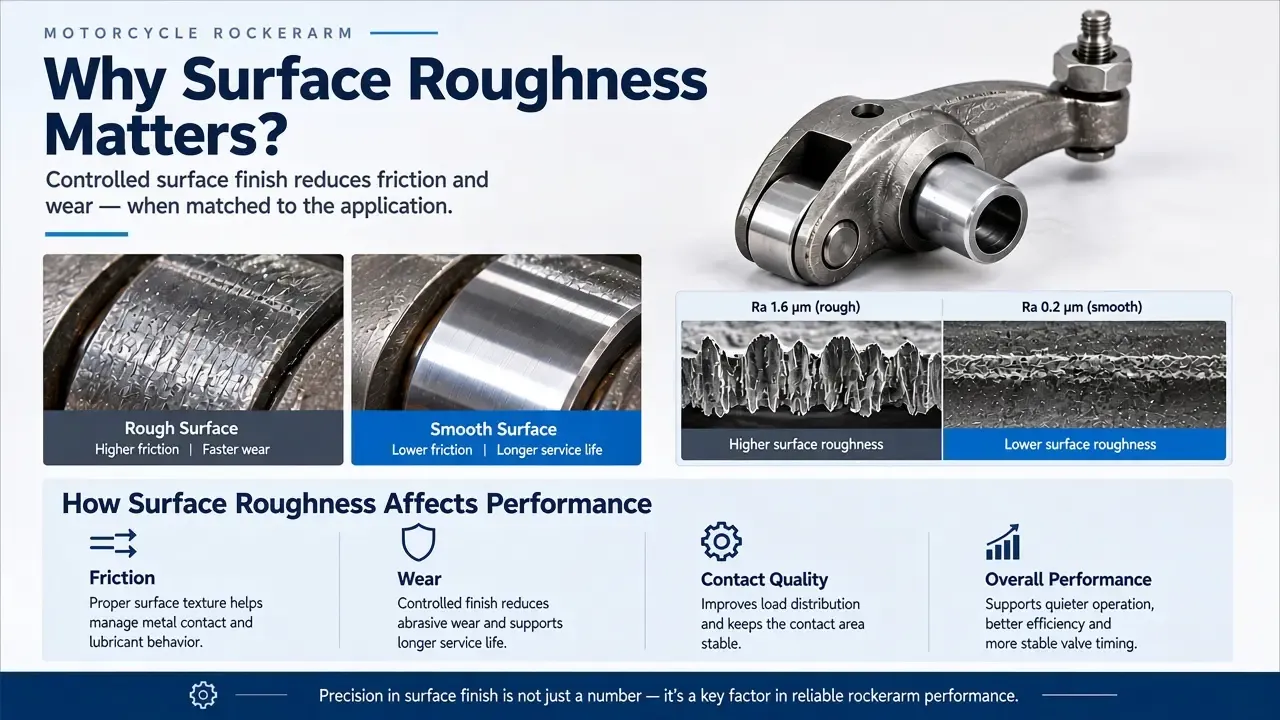
Why Does Surface Roughness Matter in Motorcycle Rocker Arm Manufacturing?
A motorcycle rocker arm may be a small component, but the quality of its contact surfaces can have a significant influence on its performance.
During engine operation, rocker arms experience repeated movement, loading and contact with other valve-train components. Surface roughness, contact geometry, material properties and lubrication all affect how these surfaces perform.
After more than 17 years of hands-on experience in motorcycle rocker arm production, I have learned that manufacturing quality is not only about meeting dimensional requirements. The details of surface finishing matter, too.
What Is Surface Roughness?
Surface roughness describes the microscopic peaks and valleys left on a material after machining, grinding or other manufacturing processes.
One commonly used parameter is Ra, which represents the arithmetic average of the absolute profile deviations from the mean line.
For example, a surface with Ra 0.2 μm has a lower average roughness than one with Ra 1.6 μm.
However, a lower Ra value does not automatically mean better performance. The appropriate surface finish depends on the component design, material, lubrication and operating conditions.
How Does Surface Roughness Affect Rocker Arm Performance?
1. Friction and Lubrication
Surface texture influences how two contacting surfaces interact and how lubricant behaves between them.
Excessive roughness may increase local contact and friction under certain conditions. However, an extremely smooth surface is not always ideal for every lubricated application.
The goal is to achieve a surface finish suitable for the intended working conditions, rather than simply making the surface as smooth as possible.
2. Wear Resistance
Surface roughness can influence wear, particularly when contact loads are high or lubrication is insufficient.
Pronounced surface irregularities may contribute to localized stress, abrasive interaction and surface damage. A properly controlled finishing process can help achieve the surface condition required for reliable operation.
Material properties, hardness, lubrication and contact pressure remain equally important. Surface finishing alone cannot guarantee a longer service life.
3. Contact Geometry
A smooth surface cannot compensate for incorrect contact geometry.
The shape and alignment of a rocker arm's functional surfaces affect how loads are transferred between components. Surface finish, dimensional accuracy and geometry must therefore be considered together.
How CNC Finishing Helps Control Surface Quality
CNC machining and specialized finishing processes can help manufacturers achieve consistent surface conditions on critical rocker arm contact areas.
Tool selection, machining parameters, machine condition and workpiece setup can all influence the final result.
In our workshop, we pay attention not only to how a surface looks, but also to whether its finish meets the requirements of the application.
The objective is not simply to produce a polished surface. It is to achieve the required surface quality consistently.
This is why visual inspection alone may not be enough. Where required, surface roughness should be measured using appropriate inspection equipment, alongside checks of geometry and critical dimensions.
Is a Smoother Surface Always Better?
Not necessarily.
A rougher surface may increase friction or wear under certain conditions, while a suitably finished surface can help improve contact behavior. However, the ideal roughness depends on the material pairing, lubrication, contact pressure and component design.
The Ra values shown in surface comparisons, such as 1.6 μm and 0.2 μm, should be treated as illustrative examples rather than universal specifications for motorcycle rocker arms.
The right target is the surface finish required by the application—not the lowest possible Ra value.
What Should Engineers Consider?
When evaluating a motorcycle rocker arm contact surface, three questions are worth asking:
- Surface roughness: Does the finish meet the engineering specification?
- Contact geometry: Are the shape and alignment suitable for the mating components?
- Process consistency: Can the manufacturing process achieve the required result repeatedly?
These factors work together. A surface may meet its roughness specification while still having a geometry or dimensional issue that needs attention.
Conclusion
Surface finishing is an important part of motorcycle rocker arm manufacturing because it can influence friction, wear and contact performance.
However, reliable results depend on more than surface roughness alone. Material properties, hardness, lubrication, contact geometry and dimensional accuracy all contribute to the final performance.
After more than 17 years on the shop floor, one lesson remains clear: small manufacturing details can make a meaningful difference to how a component performs in service.
The right surface finish is the one that meets the application's requirements and can be achieved consistently through a controlled manufacturing process.